

I wish this was a joke.
I can assure you it's not.
My name is Emily Graves…or as I used to be called, before I was taken to a new home. I formerly lived in Rock Island, IL with my mother and brother, who I can't mention due to the respect of their privacy living a few miles in Silvis. I'm 30 years old—or 29, I was when this all began—and I'm Caucasian, to clear that out for those who're race-sensitive.
Time has a way of unraveling when you're two feet tall and trapped in a world that suddenly feels designed for giant, after you catch the virus. For context, I used to stand five-foot-seven, with a lean physique that I took pride in maintaining. My dark auburn hair cascaded past my shoulders in soft waves, and my green eyes—the only feature I've managed to keep—once viewed the world with ambition. Now, they're wide with caution, darting around like prey in a jungle.
I wasn’t the first infected. I was the latest in the stand that all began two years ago.
The first reports of what we now call the "Minim Virus" emerged in Japan. The news trickled out in whispers, blending with the usual mix of bizarre headlines and conspiracy theories. "Strange Illness Reported in Osaka: People Losing Inches Overnight!" It sounded like the premise of a bad science fiction movie, which you watch late at night with a bowl of popcorn, rolling your eyes at the ridiculousness. But within weeks, those whispers turned into a deafening roar.
At first, it was just a matter of inches. A man in Kyoto woke up three inches shorter than he had been the night before. Then came another case in Tokyo, a woman who shrank nearly a foot in under a week. When the virus's true nature was revealed, neighborhoods reported clusters of shrunken citizens. The frightening part wasn't just the shrinking but the unpredictability of it all. Some people lost a few inches for feet and stopped. Others dwindled down to the size of an action figure and kept going, becoming what the media grotesquely labeled "micros." There were also reports of people losing their continence, and was labeled as a side effect of the virus, forcing shrinkees to use diapers for their toilet usage.
Japan's population was already in decline, figuratively speaking. The virus made it a harsh reality. Streets that once buzzed with life turned into ghost towns overnight as the infected stayed indoors, too terrified to face a world that had suddenly become unrecognizable. Scientists were in a frenzy, trying to figure it out. Was it spread through the air? Through water? Was it even contagious? The reality was frustratingly hard to pin down. They understood this: the virus didn't kill you outright. Instead, it changed you. It took away your size, your dignity, and for many, even their sanity.
Governments were at a loss on how to handle the situation. After the pandemic, laws were rewritten to accommodate the newly miniaturized population. Those less than their normal heights to two feet tall were considered “shrinkees,” and treated based on the height. However, those who shrank to doll size or smaller were seen as something less. Individuals the size of dolls became commodities in certain circles, treated as novelties or curiosities, while the micros were viewed as pests. It was not unusual to hear terrifying tales of micros being accidentally—or even intentionally—stepped on, swept away, or worse.
Businesses adapted swiftly, as one would expect. The world was falling apart, yet capitalism seized every chance. Entire industries emerged almost instantly to serve the reduced population. Clothing manufacturers started creating tiny wardrobes. Furniture companies introduced collections of dollhouse-sized essentials. Diaper manufacturers, like Luvs or Huggies, broadened their offerings, understanding that incontinence among the shrunken was a reliable market, so they added adult people to the packaging along with the babies. And then there were the more sinister industries, those that took advantage of the shrunken in ways too dreadful to describe.
It's been a few years since the worst of it all. The virus has eased up, though the reasons remain unclear. Perhaps it has simply run its course, or it's evolving into something new. The population has shrunk to nearly half, resulting in a bizarre and broken world. Tiny communities flourish in deserted houses and dollhouses while individuals like me try to navigate a reality that no longer accommodates us. But I'm getting ahead of myself...
So, how did I catch the virus and end up standing just 2 feet tall? I've pondered that question countless times, and I come up empty every time. It all began quite innocently—perhaps too innocently—on September 15th. I was on the late shift at the truck stop kitchen, where truckers and weary travelers drop in for greasy burgers, strong black coffee, and whatever trinkets they can scrounge from the shelves. The virus was already making headlines every Autumn, but it felt so far away, like it was happening to someone else in another place. Sure, we had seen a few mini-sized truckers come through, their tiny rigs an unsettling sight, but I never imagined it would affect me.
That night, I was utterly worn out. I had spent hours grilling burgers, talking with travelers—some of them regular-sized, others shrunken—and trying to avoid the occasional inappropriate remark. When I finally got into bed, I could hardly muster the energy to take off my shoes. I fell into a deep sleep, the kind where dreams and reality mix, and when I woke up, the first thing I noticed was my work uniform. It felt… a little loose.
At first, I didn't think much of it. I might have lost a little weight. Stress can have that effect, right? I tightened my belt and carried on with my day. The next morning, I noticed the same thing. My clothes felt even looser. I joked to myself that my new diet of truck-stop food was finally paying off. But by the end of the week, on September 22nd, it stopped being funny. At 5 feet tall, my pants nearly fell off, and my work apron was dragging on the ground.
I walked into work that morning, and my boss, a straightforward woman named Carol, raised an eyebrow and said, "Hey, Emily, you seem shorter than usual."
"Very funny," I replied, assuming it was just a joke. But as I continued my shift, the wrappers on the shelves appeared to be higher. The ovens seemed taller, too. Usually, everything was easy to reach, but now I found myself having to stretch—really stretch—to grab what I needed. The realization struck me hard: I wasn't just imagining it. I was shrinking.
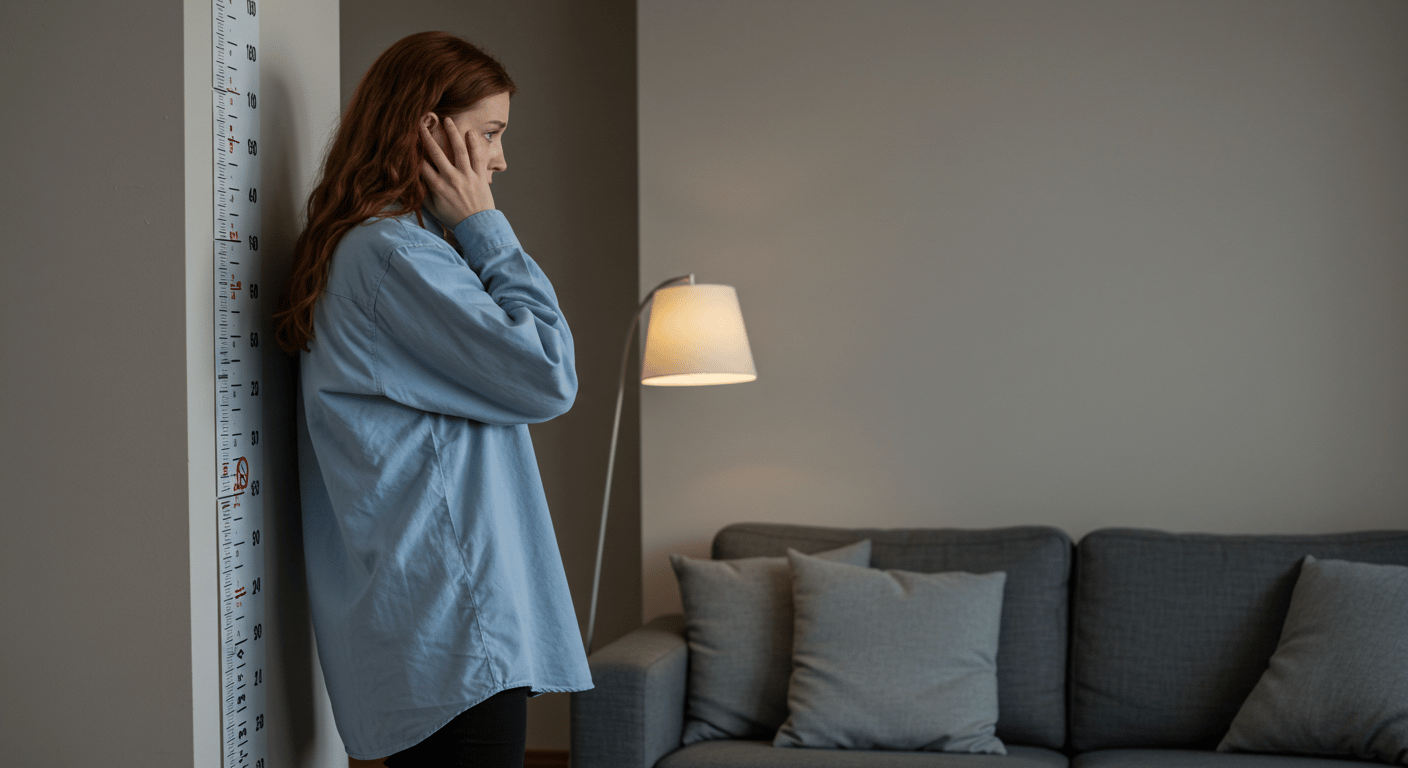
By the end of my shift, Carol called me into the office. Her expression was serious, almost maternal, which was unusual for her. She explained that she noticed something different this morning than the previous days when she saw me next to the height chart at the store's entrance, where I seemed to shrink to just 5 feet tall. "Emily, I think you should get checked out."
"I'm fine," I said, emphasizing more than I meant to. "I can still do my job. I won't let some virus get in my way."
"I understand this may seem like a long shot and something you'd prefer to steer clear of," she said softly, "but I've witnessed people contract the Minim Virus, even at this stage. So, I'm encouraging you to see a doctor immediately and get checked. If that turns out to be the case, please keep me posted. Thank you for all you've done for us."
I hesitated but eventually agreed. After finishing my shift, I headed home, feeling a sense of disappointment eating away at me. My clothes felt so baggy that I had to rummage through my closet for a belt to hold my pants up. The following morning, September 23rd, I scheduled an appointment, and on Monday, September 25th, I put on a mask, fully aware of the irony. The waiting room at the doctor's office was filled with a mix of average-sized and noticeably smaller patients, all wearing the same weary expression. At this point, I was wearing Petite Extra Small Size clothes, a stark comparison to regular Women's Extra Small, whose cup size went from 34C to 30D, and a women's size three underwear from a size 5. But the worst thing was I was starting to wear children's shoes again—size 5. I used to wear a women's size 9 shoe if you want that info.
Anyway, the doctor was a kind, middle-aged man with salt-and-pepper hair. After examining me and running a few tests, he returned with the news I dreaded: I had the Minim Virus. He explained everything in clinical terms, his voice steady but laced with sympathy. "At your current height of 4'9", you'll keep shrinking until your body stabilizes at a new size. It's difficult to predict precisely how small you'll get or what side effects you'll experience, but given your current rate of just over an inch a day, you'll stop around two feet in over a month.
"Two feet?!" I was shocked, hearing how small I would get.
"Take it easy, Miss Graves. I realize that might seem minor, but I've gained a lot of insight since the pandemic about how the virus can affect the body over time. Your boss mentioned it's been nine days since you contracted the virus. Fortunately, this variant isn't as severe as the one we dealt with two years ago."
"W-what does that mean for my job? My family?" I asked, though I already knew the answer.
He sighed as he passed me a card with a phone number. "I'm sorry, but you must submit your early retirement and prepare for a life-altering experience. The virus alters everything, including your abilities and your usual way of living. Consider it a step back into dependence. You'll have to apply for assistance. Give them a call. And based on how much you lose, you may require a caretaker."
A caretaker…more like a babysitter to me. Even the term "caretaker" struck me hard, like a punch to the gut. I was reluctant to confront the idea of losing my independence, of depending on someone else for even the most minor tasks. Yet, as I glanced down at my clothes, my belt struggling to keep my pants up, I understood I had no choice. The virus had robbed me of that freedom, just as it had taken so much from countless others.
I got home and called work and my family to inform them. I could hear the disappointment in my colleagues, my mother, and my brother's voices as they realized the virus had taken a significant toll on my life, fully aware that I was shrinking by an inch per day, which is just awful. The doctor's words replayed in my mind. I looked at the hotline number he had given me, the card for government assistance for victims of the Minim Virus, knowing that calling it was my next step. The operator on the other end was calm and professional as she asked a series of questions: Was I experiencing active shrinking? What was my current height? Did I have any underlying health issues? Each answer felt like another nail in the coffin of my former life.
By the end of the call, the operator told me they had found a caretaker for me—a woman named Aiesha. To my surprise, she doesn't have a family. But that's not the only thing. The operator also informed me of a "Stork" who'll deliver me to the new home. Her name is Aisha Manning.
Yeah, they call people who deliver shrinkees like me "Storks" like the fictional bird who delivers newborns to homes. How fitting.
I
had expected to remain in my own home, clinging to the independence I had left, but now I was informed that I needed to move in with someone else.
I'm getting adopted…
At the age of 29…
The thought made my stomach turn, but the virus was still taking its toll on me, and so was the bureaucracy. The operator assigned me a task: the government would handle selling my belongings, house, and car, but I needed to gather whatever clothes I could still wear.
The task felt daunting. I had invested years in building a life, only to watch it crumble piece by piece. I had just 8-10 days before the Stork would come to pick me up. The new caretaker lives in Chicago, Illinois, which is across the state, making the idea of leaving my hometown and family I had even more challenging, thanks to the stupid law against people with the virus. The only silver lining was the money I would receive from selling everything, but even that didn't feel like it truly belonged to me. It would go to the caretaker, someone I hadn't even met yet, who would now take control of my life. It felt like I was regressing like a child being sent back to live with their mother…only that I'm going to live with a different mother than the one I have.
A sense of emptiness washed over me when I finally ended the call and put down the phone. The life I had always known was fading away, and with every day that passed, the gap between my current self and the person I was destined to become seemed to widen. All that was left was to move forward—regardless of how afraid I felt.
As the days passed waiting for the caretaker, so did the inches and clothing sizes I lost. During that week of waiting, my mother and brother stopped by and saw my dwindled state and decided to stay for the next couple of days. They helped me along the way while I constantly switched between clothes to try and maintain myself. I became more mortified daily, from Petite XXLs to Children's Mediums and Smalls in the clothing department.
Then, on the morning of October 1st, I received a call from Aisha, the person assigned to be my Stork. The first thing that struck me was her voice—deep and rich, with a soothing rhythm that effortlessly captured attention. There was a comforting warmth in her tone, the kind of voice you'd trust to reassure you that everything would be alright, even when chaos surrounded you. Yet, beneath that warmth lay a firmness, a quiet authority that left no room for debate. It was the voice of someone who knew how to lead and expected you to follow.
"This is Aisha Manning from the Chicago Minim Transporter Service," she said, her words deliberate and clear, with a slight hint of a Chicago accent. "I'll be your Stork to deliver you to your new home with a…Amanda Johnson. I wanted to check in and let you know I'll be there tomorrow morning around nine."
Even through the phone, I could envision her—a tall, self-assured woman who likely entered a room and immediately took control. Her voice made me feel reassured and slightly anxious, as if she could see right through me despite the distance.
This is it.
And like that, the next day arrives.
October 2nd.
I reached a height of four feet, after being measured by a standing ruler against the wall of my bedroom.
I stood in front of the mirror, looking at the outfit representing my departure from my house and life. The familiar silhouettes of my adult clothes were gone, replaced by the vibrant colors and fun patterns of children's clothing that my mother and brother helped before they left yesterday afternoon.
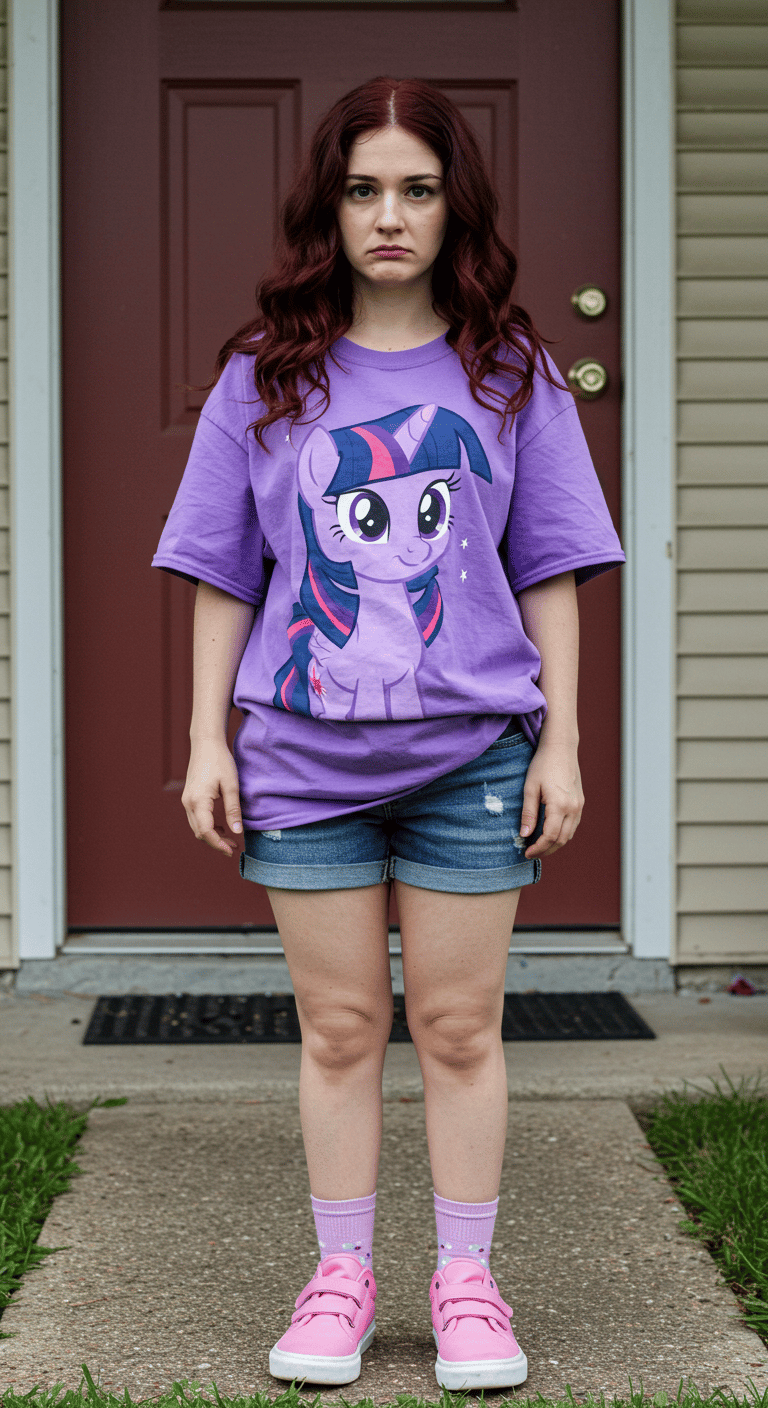
My top was a girl's size small, featuring the iconic image of Twilight Sparkle from My Little Pony. I picked it up at the local Target in Rock Island, and it fit snugly against my smaller frame. I could almost hear the laughter of those who would call a 29-year-old woman or any adult who enjoys the show a "Brony." Let them chuckle; they don't like the series as much as I do.
Underneath, I wore a pair of size 14 denim shorts from the kids' section at Kohl's. The waistband fit well, but the length was a little shorter than I preferred. Modesty was yet another compromise I had to accept. Luckily, the weather was pleasantly warm for early October, making it a good day for shorts.
The real challenge, however, had been finding the proper undergarments. My old bra size, a 34C, felt like a thing of the past. After searching through specialty boutiques and dealing with the condescending smiles of sales clerks, I finally chose a training bra from a small online shop, size 28A. The fit was decent, but the style—pastel pink with frills—was aimed at preteens. For underwear, girls' size six briefs worked…I had to choose My Little Pony-style underwear with Twilight Sparkle on it.
The outfit was completed with pink girl's socks matching pink children's size 2.5 sneakers bought from a local shoe store in downtown Rock Island. The light-up soles added an unexpected touch, glowing playfully with every step. I could picture the neighborhood kids feeling a bit jealous.
The anticipation grew each second as I stared out the window, wondering what kind of car she'd drive. Finally, a dark SUV pulled into my driveway, and my stomach tightened. Maybe it was her.
The door swung open, revealing a woman who looked like she had stepped out of a magazine, but not one filled with unrealistic ideals. Aiesha Manning was captivating in a genuine way, a mix of strength and grace that drew attention. Her long, jet-black hair was thick and shiny, cascading in soft waves past her shoulders, with the sun highlighting subtle hints of dark chestnut. It framed a face that was both striking and approachable—high cheekbones, a strong jawline, and full lips adorned with a soft mauve hue. Her almond-shaped eyes, a warm, rich brown, exuded a quiet confidence that could make anyone feel both at ease and a bit intimidated.
Her deep caramel skin seemed to glow in the sunlight, perfectly complementing her simple yet stylish outfit. She wore a tailored olive-green blouse that hinted at her curves without being overly revealing, tucked neatly into high-waisted black slacks that hugged her wide hips and long legs. Pantyhose and high-heeled shoes fit her to a T. Not to mention she had a lanyard hung over her neck with a card attached, turned on her chest area. Her physique was athletic yet feminine—broad shoulders, a toned figure, and an hourglass shape that suggested a life of discipline and care.
Black ankle boots with a slight heel were on her feet, polished enough to catch the light, adding a touch of authority to her purposeful walk. She carried a sleek black crossbody bag that rested against her side, and around her neck hung a delicate gold chain, catching the occasional glimmer of sunlight.
Her posture was impeccable—back straight, shoulders squared, and each step deliberate as she approached the door. The atmosphere around her seemed to change as if her presence commanded respect. Even the way she pressed the doorbell felt intentional, her finger moving with a precise grace that reflected her overall demeanor.
When I heard the knock at the door, I felt a flutter of nerves in my stomach. As I walked across the living room, I felt ridiculously small in my light-up sneakers. At just four feet tall, the doorknob was right below my waist, and the door seemed to tower over me like a giant structure. Taking a deep breath, I opened the door and had to tilt my head back to look into the eyes of the woman on the porch.
She was taller than I'd anticipated—though at this height, who wasn't? Her smile was warm, but a knowing glint in her eyes instantly put me on edge. Her gaze lingered on my outfit. She stifled a grin and raised an eyebrow.
"Well, aren't you just adorable?" she said, her tone light yet undeniably teasing. "Twilight Sparkle and all."
My cheeks flushed, and I crossed my arms over my chest. " Very funny," I muttered.
She laughed, stepping inside without waiting for an invitation. "Hey, just a compliment. You do look cute, though. Not exactly a good start, huh?"
"You think?" I shot back, raising an eyebrow.
Her laughter flowed easily, carefree, and unbothered. "Okay, start over. Emily, right? Can you show me your ID for verification?"
I nodded, trying to ignore the fact that her chest was slightly above my eye level as I reached for my driver's license from my oversized purse nearby. Handing it to her with a hint of reluctance, I said, "Yeah, that's me."
"Well, Emily," she said, extending her hand, her voice steady yet kind, "I'm Aiesha Manning. I'm here to help you settle into your new home. The Chicago office sent me to be your Stork to be delivered to your caretaker's home. Now," she continued, her tone firm but not unkind, "I'll take your purse and ID since you won't be needing them anymore."
"Great," I muttered as she grabbed my purse and carried it to her vehicle, its oversized bulk looking almost comical in her hands. "And I guess they told you to take my IDs and everything? Or was the 'cute' comment just your personal touch?"
She grinned, unfazed by my sarcasm. "Oh, the taking of your IDs? That's standard procedure from the government. But the 'cute' comment? That's all me." She raised an eyebrow, her tone light yet firm. "So, are you all packed and ready to go?"
"Yeah, my suitcase is in the bedroom. I'll grab it." I turned and stomped off, the soles of my sneakers flashing with every step. Behind me, I heard Aiesha chuckle again.
"I'm just saying," she called after me. "If you're stuck wearing that, you might as well own it."
Her tone was kind yet straightforward. I nodded again and rushed to grab the bags I had packed, shoving the last of my clothes into them. Aiesha followed me to the SUV and helped me load everything into the back, just behind the rear seat.
As she closed the trunk, she asked me, "How tall are you now?"
"Four feet," I replied, feeling the weight of my words.
She raised an eyebrow and nodded. "Alright. Since you're under four foot nine, we'll need to stop nearby and get you a backless booster seat quickly."
I froze, my cheeks flushing. "A booster seat…? Seriously?"
Aiesha's expression remained unchanged. "State law requires it for kids under four foot nine. That includes you now. Unless you want to explain to a cop why you're not in one."
Her words hit hard, and I felt a lump in my throat. "I'm not a kid," I muttered.
Aiesha's eyes narrowed slightly, her tone becoming sharper. "Your clothes say otherwise. Do you need a whoopin' to remind you who's in charge here?"
I blinked at her in disbelief and, feeling defensive, muttered, "Go ahead, try. I'm 29 years old."
Without missing a beat, Aiesha grabbed my arm and swatted me twice on the backside. Each hit stung. "Now, are you going to behave, or do you need another reminder to show you that age for the shrunken is just a number?" she asked, her voice steady but firm.
Now, you would think that spanking to discipline a child is child abuse.
When you’re a shrinkee, that rule is off the table.
Tears welled in my eyes, and I swallowed my pride, climbed into the back seat, and placed my seatbelt on without another word. At four feet tall, even climbing into cars becomes a challenge. Usually, I get in one without effort. Now, I had to crawl up to the seat with some effort. Luckily, I was able to get in and sit down. When she closed my door, Aiesha got behind the wheel and drove us to a nearby Walmart.
Once there, she parked the car and told me, "Wait here for a moment. I'll go inside."
As she walked into the store, I sat in the SUV, simmering over everything that had happened. The surreal nature of my situation hit me hard: just days ago, I was living independently, and now I was in someone else's car, waiting for her to buy me something meant for kids. Aiesha was assertive, confident, and accustomed to being in charge—traits that reassured and annoyed me. I felt conflicted between appreciating her decisiveness and resenting how powerless I felt around her. It wasn't just about the booster seat or the swats; it was the undeniable truth that my life and choices were no longer entirely my own. My pride stung as I gazed at the store entrance, preparing myself for what would come. She came back a short while later, holding a backless booster seat.
I stayed still. "I'm not going to sit in one," I replied flatly.
Aiesha's patience was wearing thin. She swung open the SUV door, took hold of my arm firmly, and helped me into the booster seat without leaving room for debate. I squirmed momentarily, but her grip was unwavering, and I understood that fighting it was futile. Once I was settled, she fastened the seatbelt and stepped back with a pleased nod.
"There. Now we're all set to go," she said.
I could feel my face flush with embarrassment, the shame of it all pressing down on me. I despised every moment of being treated like a child. Even more, I resented the government for establishing a system that dehumanized those with the Minim Virus, reducing their height to that of a typical child's age. At the same time, I sit there with my legs dangling a bit—that's another thing; my feet can't reach the floor anymore when I sit.
Aiesha had made it abundantly clear:
The government was in control of my destiny.